How the Rhino MCP Democratizes Federated Computing


Federated computing allows organizations in regulated industries to run workloads across data that remains in separate, secure silos—across institutions, departments, or geographies—without ever centralizing sensitive records.
However, for most teams, unlocking the full power has required a team member fluent in writing code and working with containers. Perhaps more importantly, these technical team members are stretched thin across projects and commitments.
We wanted to reduce the gap between what federated platforms can do and who can actually use them, enabling our customers to extract maximum value from the platform. The Rhino MCP removes that ceiling and opens the platform access to non-technical users while helping technical users move faster and with less friction.
And as agentic workloads become more common in the enterprise, our MCP server provides a secure, privacy-enhancing interface for AI agents to move human-in-the-loop (HITL) and autonomous tasks forward at scale.
What Is the Rhino MCP?
MCP (Model Context Protocol) has rapidly become the standard for connecting AI assistants, such as Claude, ChatGPT, and Gemini, to external tools and data. Where other methods and AI harnesses, like custom API integrations and orchestration frameworks like LangChain, required bespoke, per-system connections, MCP gives any AI assistant a standardized, out-of-the-box way to connect to external capabilities.
You can think of MCP as the universal connector between AI assistants and the tools and data they need to act on. MCP gives AI assistants a standardized way to discover and use external capabilities, turning a conversational AI into something that can actually do work in your existing environment, across secure data silos.
The Rhino MCP connects those AI assistants directly to the Rhino Federated Computing Platform. The result? Anyone on your team can now interact with Rhino through plain language, whether or not they write code.
The Rhino MCP is live today, with over 60 tools spanning analytics, code execution, data harmonization, monitoring, and more. Initial rollouts of the MCP have already generated significant excitement from Rhino customers across industries.
What You Can Do With the Rhino MCP
Once you’ve connected your AI assistant of choice to the Rhino Federated Computing platform in a matter of seconds, you can access core platform capabilities via a simple chat prompt, running analyses and workflows across data that may span multiple institutions, partners, or secure environments:
Insights and exploration: Understand the full context of anything you can see on Rhino by simple prompts. See what projects you have access to, highlight new additions, explore dataset schemas, profile data distributions, and aggregate insights across sites—all without direct data access.
Data preparation and harmonization: Before you run an analysis, the data has to be ready. With the Rhino MCP, you can build cohorts, compare datasets held at different institutions or internal departments for drift detection, and harmonize data to OMOP or custom vocabularies through natural language. Whether you're preparing for a clinical trial, a risk model, or a cross-institutional research study, the groundwork no longer requires a data engineer on standby.
Model and code execution: Once your data is ready, running statistical analyses is as simple as describing what you need. Run Kaplan-Meier survival curves, Cox proportional hazards models, chi-square tests, Table 1 summaries, and more without writing a single line of code. Rhino handles execution across all of your data sources simultaneously and your AI assistant surfaces results, summarizes insights, and produces visuals in clients that support rendering.
Federated learning: For more advanced workflows, you can run and train predictive models across multiple sites.
Monitoring, observability, and management: Once jobs are running, you stay in control. Check job status, pull logs, debug failures, and halt runs if needed, without leaving your AI assistant. You can also manage collaborators, verify site connectivity, and check workgroup status, keeping your full operational picture in one place.
A New Category of User
The Rhino MCP opens the platform to new, non-technical users and makes existing, technical users faster.
For non-technical users such as clinicians, analysts, and operational collaborators, you no longer need coding knowledge or a technical intermediary to get the most out of Rhino—you can do so through a conversation with your AI chatbot of choice.
For technical users, the gains are different but just as impactful. Data scientists and engineers can now use their AI assistant for AI-assisted debugging, code generation, and faster iteration, all of which remove friction without sacrificing depth.
Whether you're new to Rhino or have been using it for years, the ceiling on how quickly you can work just got a lot higher.
A Foundation for Agentic AI
Agentic AI is on everyone's agenda right now, and MCP is part of the connective tissue that makes it real and effective. AI agents don't just answer questions; they plan, execute, and iterate across multi-step workflows autonomously. MCP is what gives those agents the ability to act on real data, in real systems, in real time.
For Rhino, that means agents can reason across distributed data and take action—processing records at each site, extracting signals, running analyses—without those records ever leaving their source. The use cases this unlocks are high value and functionally innumerable. Here are a few examples of agentic systems Rhino customers can now build to create AI “co-workers” to assist in core federated workflows.
Epidemiologist Agent
Epidemiologists need large, diverse patient cohorts to produce statistically valid findings — but the EHRs, registries, and biobanks they rely on are locked behind IRB restrictions, data use agreements, and cross-border privacy regulations that make centralization impractical.
Rhino's MCP interface lets researchers direct federated analyses conversationally ("run a Cox proportional hazards model for 30-day readmission across all contributing sites, stratified by age and comorbidity index"). The researcher defines the question and interprets the result, while the agent handles query translation, federated execution, and result aggregation without patient records ever leaving their source systems. This division of labor directly addresses the epidemiologist's core need — statistical power across heterogeneous populations — while eliminating the months of data transfer negotiation that today separates each iterative step.
Because epidemiological research is inherently iterative, this becomes a force multiplier: the researcher steers the inquiry at each step while the agent handles execution, compressing a workflow that once took months per iteration into something closer to real-time.
Clinical Trial Data Manager Agent
A trial data manager at a sponsor or CRO must harmonize and query patient data across investigative sites bound by strict contractual and regulatory obligations that make centralization slow, costly, and legally complex.
Rhino's MCP interface lets managers direct cross-site queries conversationally ("flag any sites with >10% missing primary endpoint data") — the data manager defines the check, reviews the findings, and decides on remediation, while the agent handles query translation, federated execution across site-level datasets, and result aggregation without moving the data.
Because trial monitoring is continuous and multi-site, this becomes a force multiplier: the manager maintains oversight and disposition authority at each step while the agent compresses what today requires slow manual pulls or incomplete central extracts into an on-demand federated query.
Biopharma Evidence Analyst Agent
RWE analysts building external control arms or comparative effectiveness evidence need to query across claims data, EHR networks, and specialty registries — most of which cannot be centralized without significant legal and regulatory friction.
Rhino's MCP interface lets analysts direct cohort construction conversationally ("identify patients meeting these inclusion criteria across all contributing nodes") — the analyst defines the population, specifies inclusion/exclusion criteria, and interprets the aggregate results, while the agent handles query translation, federated execution, and result aggregation without moving the underlying data.
Because RWE study design is iterative — each cohort refinement informing the next — this becomes a force multiplier: the analyst retains control over every methodological decision while the agent eliminates the months of data use agreements and manual transfers that today separate each refinement.
Financial AML Analyst Agent
AML analysts need to detect patterns across transaction records that, for competitive and regulatory reasons, cannot be shared between institutions.
Rhino's MCP interface lets investigators direct cross-institutional queries conversationally ("identify entities appearing in high-risk transaction clusters across more than two contributing institutions") — the analyst defines the typology, reviews the surfaced signals, and makes all disposition decisions, while the agent runs network traversal and pattern-matching logic across siloed transaction graphs without any institution exposing raw data to another.
Because SAR filing and escalation decisions must remain with a human under FinCEN rules, this division is not just operationally clean but regulatorily required: the agent handles federated execution at a scale no manual bilateral data-sharing process could match, while the analyst retains full decisional authority over every finding.
The Rhino MCP you can connect to today is the infrastructure enablement layer that makes those workflows possible.
How It Works and Why It's Secure
We know that connecting an AI assistant to sensitive research data raises an immediate question: “What about security?”
With the Rhino MCP, the core security of our federated architecture is still intact. Raw data never leaves the site, whether that site is a partner institution or an internal business unit, and results and insights are always aggregated. The MCP server enforces the same permissions, access controls, and governance your team already relies on.
Authentication happens via OAuth 2.1,the same standard used by Google and GitHub, meaning your credentials never appear in the AI chat, and the AI assistant never sees your password. Each user authenticates with their own account, and their usage is subject to the same audit controls as the Rhino platform.
The AI doesn't get access to your data. It gets access to Rhino, which then handles your data exactly as it always has.
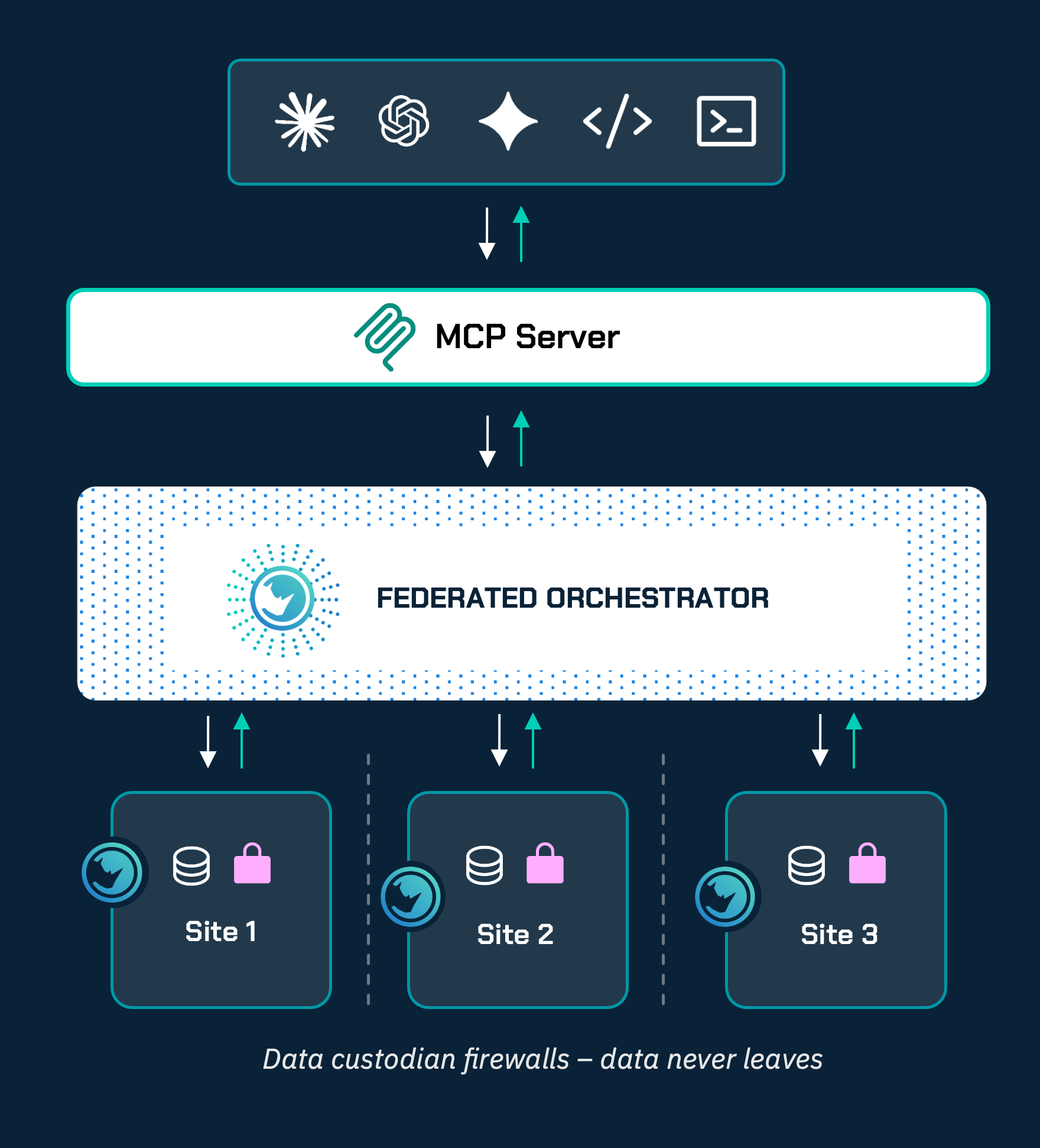
One of the best ways to conceive of the possibilities is to see how it works in practice. Check out a quick walkthrough of a real federated analytics workflow, driven entirely through natural language below. We'll feature more content on our blog in the coming weeks showing the many opportunities our MCP server opens up for humans and agents alike.
Getting Started
If you're already a Rhino customer, setup takes under five minutes for most LLM apps for the Rhino MCP. If you’re not yet a Rhino customer and want to learn more about how the Rhino MCP could help your organization bring agentic AI to your most sensitive data workflows, reach out to our team for a personalized demo today.


